
Options to Help Save the Trees in the VDOT Rights of Way
In Northern Virginia, VDOT will issue a permit in specific situations for volunteers, neighborhoods, communities, or organizations to control tree-threatening invasive plants where doing so could pose no risk to drivers or trail users or to the volunteers themselves from traffic. Working in the right of way without a permit is not allowed, with one exception: permits are NOT required if you own the land adjacent to the roadside right away, per Virginia code, and you are controlling invasive plants that could impact your property. § 33.2-217. Prohibition of certain weeds and plants on highway rights-of-way
Permits will not be issued for limited-access highways or for most, if not all, medians and interchanges. Other areas might be off limits as well, such as near certain government installations.
Volunteers must follow the same safety rules that apply toAdopt-a-Highway volunteers.
It is not permitted to cut or kill any plant that could fall onto a road, trail, neighboring property, or any human-made object or infrastructure, either immediately or later as a result of your action.
Individual volunteers or hired workers without a certified pesticide applicator license
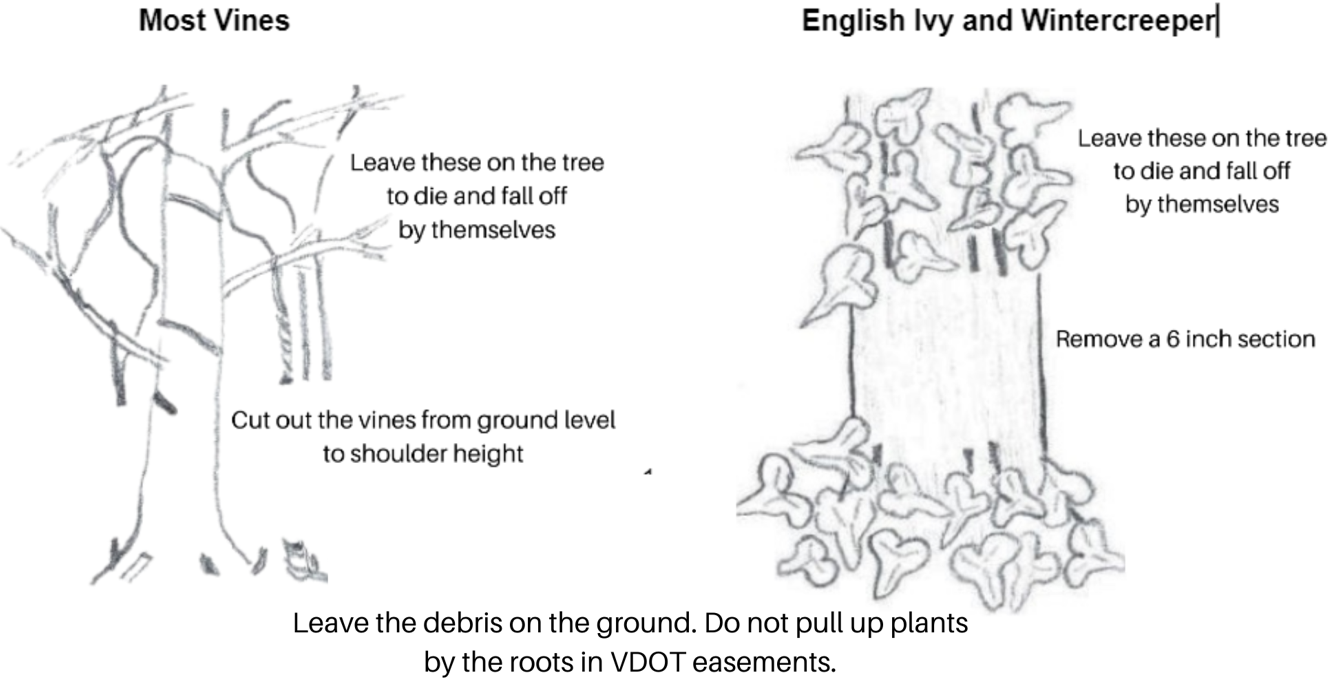
For draping invasive non-native vines (and tree-killing shrubs), cut the vine near the ground and again at shoulder height, then take down the plant material in between to eliminate the “ladder” for vines to grow back up. Do not try to pull vines down from higher up, as that might injury the tree or bring a branch down on your head. Those plants include
- Porcelain Berry
- Asian (Oriental) Bittersweet
- Asian (Chinese or Japanese) Wisteria
- Japanese Honeysuckle
- Five-leaved Akebia
- Kudzu
- Multiflora Rose
- Thorny Elaeagnus
For clinging invasive vines, cut at the base and again six inches or so higher, clearing out a window in between. Those vines include
- English Ivy
- Wintercreeper
This will kill the vine on the tree and temporarily allow the tree to breathe. The vines will regrow from the roots, though. Leave the debris on the ground. If it has roots, try to suspend it somewhere where they can dryout and wither.
Do not clip native vines or other native plants. Native vines include
- Grape
- Virginia Creeper
- Greenbrier
- Trumpet Creeper
- Poison Ivy
For invasive trees and shrubs less than eight feet high that crowd out native tree seedlings, it is permissible to cut the plant down, as long as there is no chance it can fall on a road, trail, neighboring property, or any human-made object or infrastructure. Those plants include
- Callery Pear
- Autumn Olive
- Paulownia
- Mimosa
- Chinese or Border Privet
- Amur Honeysuckle
- Japanese Spirea
- Japanese Barberry
- Burning Bush
- Nandina
Cutting down these plants does not kill them - they will resprout. Repeated cutting several times a year may eventually exhaust their energy stores. Some plants including Autumn Olive may send up numerous root sprouts unless herbicide is applied immediately to the cut stump (only Certified Pesticide Applicators may do that). Always consult recommendations from reputable sources such as Blue Ridge PRISM before cutting anything.
It is NOT PERMITTED to cut the following
- Tree-of-Heaven (cutting without first killing the plant causes it to send hundreds of suckers, making the situation worse)
- Any tree or shrub higher than eight feet tall
- Any plant that has the potential to fall on a road, trail, neighboring property, or any human-made object or infrastructure.
- Any native plant
- Perennials or grasses
Be aware that cutting certain plants such as Japanese Knotweed can make the situation much, much worse.
Paid workers with a commercial pesticide applicator license
It is permitted to hire licensed companies to treat the invasive plants specified above. They may use unrestricted herbicides for cut-stump, basal bark, or hack-and-squirt treatments but not for foliar spray. They must follow the recommendations for each invasive plant species as outlined by Virginia Cooperative Extension or Virginia Department of Forestry guidelines. It is permissible for them to use herbicides on larger plants but only if the distance from any road, trail, neighboring property, or any human-made object or infrastructure is at least as much as the height of the tree or shrub.
Permitting procedure
- Fill out this VDOT permit form and submit it at least 30 days in advance with a map showing where you plan to work
- In Fairfax/Arlington/Alexandria, to Aminul Chowdhury
This email address is being protected from spambots. You need JavaScript enabled to view it. - In Prince William, to Kim Yeatman
This email address is being protected from spambots. You need JavaScript enabled to view it. - In Loudoun, to Travis Duncan
This email address is being protected from spambots. You need JavaScript enabled to view it.
- Request a waiver of the bonding and surety requirement. These requests are evaluated on a case-by-case basis. www.virginiadot.org/business/fairfax-permits-main.asp
- If you are also requesting that a Certified Pesticide Applicator be allowed to apply herbicides, submit the Chemical Control of Vegetation (LUP_CCV) form as well.
- Take the permit with you while you are working. Make sure you are working only on VDOT land and not encroaching on someone else’s property! Google My Maps has a measuring tool to help you determine the distance from the curb. You could also use a property boundary app on your mobile phone such as HuntStand.
Possible scenarios (in all cases only in areas where there is safe access - which you can describe on the form - and where the volunteer can stand clear of the roadway)
- ROW next to public property or commercial property
- ROW between a trail and a sound barrier
- ROW inside a clover leaf or on a median strip where there is safe access
- Right of way adjacent to residential property - please note that homeowners might not understand that the ROW belongs to VDOT. They may have been mowing or gardening right down to the road. Consider working somewhere else if this could be an issue.
Not all roads belong to VDOT!
To find out first who maintains your road (VDOT, privately owned/maintained, or other):
Here is a nice map of VDOT-owned properties. It is full of interesting surprises! Zoom in and wait for it to load. But cross-check with the road-ownership map to make sure it’s actually VDOT’s right of way.