Volunteering to Snip Invasive Vines on Trees in VDOT Rights of Way
In Northern Virginia, VDOT will issue a permit in specific situations for volunteers to snip invasive non-native plants that threaten native trees in their right of way, where doing so could pose no risk to drivers or trail users or to the volunteers themselves from traffic. Working in the right of way without a permit is not allowed.
Permits will not be issued for limited-access highways. Other areas might be off limits as well, such as near certain government installations.
Volunteers must follow the same safety rules that apply toAdopt-a-Highway volunteers . You will be volunteering for VDOT, not for any other organization, when you are doing this.
What volunteers may do:
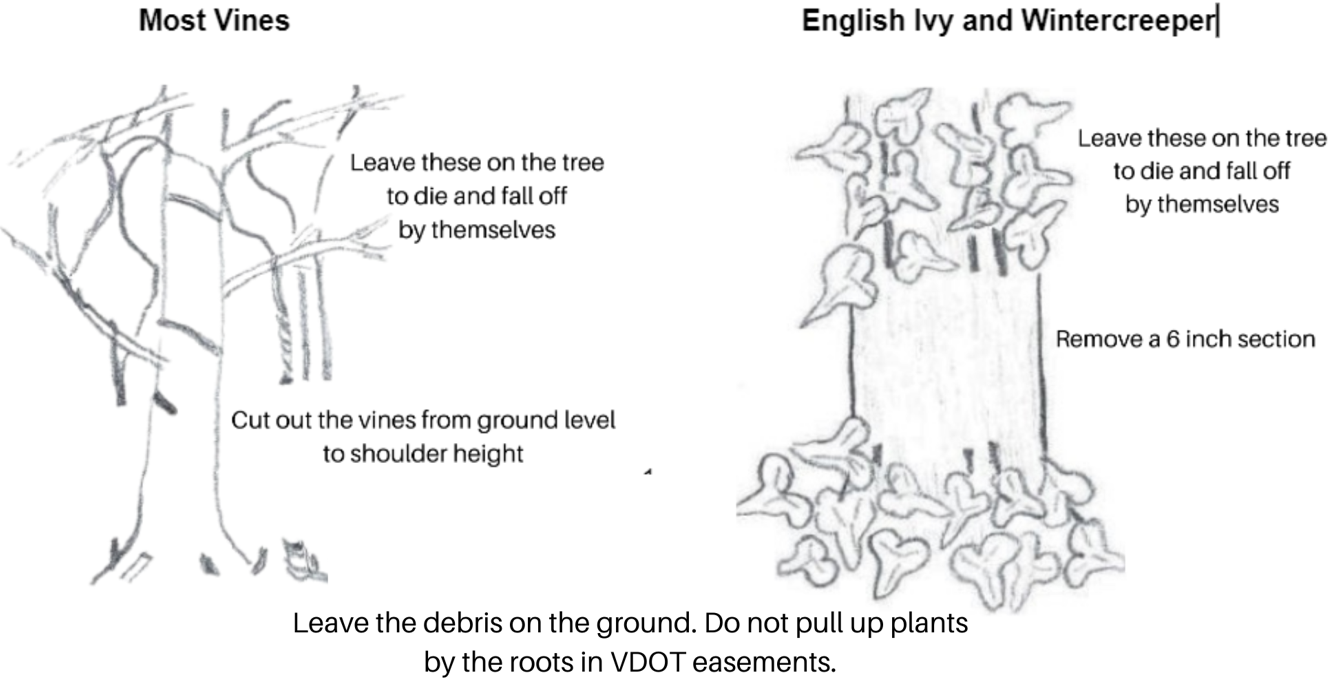
For draping invasive non-native vines such as Porcelain Berry, Oriental Bittersweet, and Japanese Honeysuckle, cut the vine near the ground and again at shoulder height, then take down the plant material in between to eliminate the “ladder” for vines to grow back up. Do not try to pull vines down from higher up, as that might injury the tree or bring a branch down on your head. Do not clip native vines.
For clinging vines such as English Ivy and Wintercreeper, cut at the base and again six inches or so higher, clearing out a window in between.
This will kill the vine on the tree and temporarily allow the tree to breathe. The vines will regrow from the roots, though.
Procedure:
- In Fairfax/Arlington/Alexandria/Prince William, use the procedure on this page .
- In Loudoun, fill out a LUP-A form and submit it at least 30 days in advance, with a map showing where you plan to work, to Travis Duncan
This email address is being protected from spambots. You need JavaScript enabled to view it. - Request a waiver of the bonding and surety requirement. These requests are evaluated on a case-by-case basis. www.virginiadot.org/business/fairfax-permits-main.asp
- Take the permit with you while you are working. Make sure you are working only on VDOT land and not encroaching on someone else’s property! Google My Maps has a measuring tool to help you determine the distance from the curb.You could also use a property boundary app on your mobile phone such as HuntStand.
Possible scenarios (in all cases only in areas where there is safe access - which you can describe on the form - and where the volunteer can stand clear of the roadway)
- ROW next to public property or commercial property
- ROW between a trail and a sound barrier
- ROW inside a clover leaf or on a median strip where there is safe access
- Right of way adjacent to residential property - please note that homeowners might not understand that the ROW belongs to VDOT. They may have been mowing or gardening right down to the road. Consider working somewhere else if this could be an issue.
Not all roads belong to VDOT!
To find out first who maintains your road (VDOT, privately owned/maintained, or other):